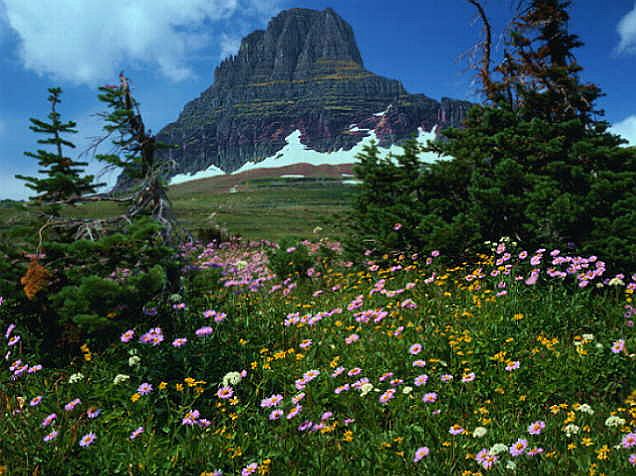
 In the fourth movement the protagonist learns many things leading up to the revelation of Nature. The music is a joyous celebration of life and is the fastest paced and most complicated both musically and in the story line of all the movements. There are three endings. The very grand first ending is how the protagonist feels while still enjoying the luxury of ignorance prior to the revelation. The serene second ending is the revelation. In the very triumphant third ending, Nature celebrates the resolve of the protagonist to teach his understanding to humankind so that all can enjoy the utopia that has always been present but obscured by humankind's intent on self-deification. The concluding third ending (Part 5) was composed in 1969. It was partially orchestrated in 2003 for synthesizer performance and fully orchestrated in 2024. The rest of the movement was completed in late 1981 combining work done in previous years. A piano recording of the movement was made on February 13, 1982, and served as the documentation until a method to write it using computer became available. This was the second movement to be completed. The piano recording was transcribed to a Cakewalk file in the mid-1990s and was later refined for orchestral performance on the synthesizer. The movement begins with a pastoral setting as a bright trumpet call plays a new variation on the opening phrase of the Hymn to Nature. Then the full orchestra joins in a celebration of all the colors and life that are appearing everywhere. All the wildlife are now up and about with new offspring that are learning about the world. A triumphal march announces a reunion of the wildlife society for the coming summer. The trek theme is recalled as the protagonist is once again in great stride. After the opening call of this section is heard one last time the music builds in transition to the celebration that the migration of last fall is returning. A march announces the return of the southern migration. This march is somewhat reminiscent of the southward migration theme from the second movement but is now triumphant and is in the odd time signatures for a march of 7/4 and 5/4 (I have considered referring to this as the syncopated march -- although it does not sound syncopated). Everything is growing rapidly to restore the majesty of the approaching summer. Musical vista after musical vista is heard. The protagonist is in awe of the incredible beauty and intricacy of it all. So much is working together in perfect harmony as the music builds to a climax. After a climax, the frolic theme is heard slowly and resolutely by a bass clarinet as the music becomes serene as the protagonist contemplates all that is around. A variation of the frolic theme is heard magically and mysteriously as Nature communicates much understanding to the protagonist and the pace of the music picks up. The music becomes triumphant as the protagonist now believes he has achieved the goal of understanding but that is premature. A very grandeur coda builds to the first ending. There is a feeling of triumph and celebration as the closing four-note theme (God's theme) of the first ending makes its appearance and builds to a grand climax. The protagonist feels as one with all of Nature. Nature is a beautiful and wonderful place that is eternal. Surely there can be no higher climax than what is taking place now on this bright spring day. It seems as if the protagonist's journey and the music as well are now completed. But there is still much more to learn. The music suddenly becomes mysterious and troubled as the protagonist observes the carcass of the mountain goat from the previous summer and also that various animals from the previous summer are missing. Even some of the majestic trees did not survive winter. How could such a wonderful place have such tragedy? The protagonist sadly recalls earlier times of joy while trying to make sense of this. The quest is not complete as there is obviously something missing in his understanding. In his despair he looks up and is drawn to a grand vista as soft tones in the upper orchestral and a subtle harmony change hints at a resolution (a subliminal communication from his unseen guide). It is a brilliantly colored hillside dotted with massive boulders next to a dense forest leading up to the mountain peak. After a pause, the music picks up as he is compelled to run up the hillside towards the dense forest. Upon arrival, he turns to see the grand view below, and the music once again becomes very majestic and rapidly builds to a loud and sustained clashing chord representing the great inner conflict the protagonist has trying to reconcile great beauty with death. After a silent pause in the music, the protagonist enters the forest as there is something that draws him in. He notices something strange. The light should be dim in such a dense forest, but it is not. There is light everywhere. Even though the light is very brilliant it is not blinding. The music has resolved to serenity. He proceeds deeper into the forest and then sees a very strange sight. All the vegetation now transforms into the spirit image of every creature that has ever lived. Predator and prey sit beside each other in harmony now that they are no longer bound by mortal bodies. He sees the spirit of the mountain goat of last summer standing tall. He continues in pure wonderment as the music builds to a soft climax. The protagonist then notices an individual sitting amid all these spirits. He is obviously very old but yet has everlasting youth. The protagonist now realizes that his unseen guide has been God Himself. The subtle tension that had been in the music leading to the soft climax now relaxes and becomes a serene and a resolves to a tranquil three-note version of God's theme. God is smiling and is proud of the protagonist for making the effort to learn about Nature. As has been before, no words spoken, but a great understanding takes place in the mind of the protagonist. He now understands the full cycle of life and death and how all of Nature works in harmony and that all life is interdependent on other life. His friends of last summer are not gone as their spirits live on in all the new life of this year and years to come. Every living thing has a purpose in mortal life and that life itself is only a part of the grand scheme. Death is the transformation of life into a different entity, and all present life depends on past life, and all future life depends on present life. Life itself is everlasting but in different reclaimed forms. All life has a right to be and must be for all of Nature to work. Killing is proper or necessary only if done to sustain other life. The revelation is that God and Nature are one in the same and omnipresent. All life except humans simply lives and dies by the laws of Nature. Humans are granted an exception via higher intellect as God would be lonely without some entity capable not only of marveling His creation but also eager to understand how it works and relate to and appreciate it. Human life is not possible without all other life in Nature. It is crucial for humans to understand this lest they destroy Nature and thus themselves. God is disappointed in humans that misuse their intellect to destroy rather than thrive in harmony as was intended. Manmade religions become self-glorifying and the basis for domination and the supposed correction of presumed mistakes by God. The ultimate worship to God is to admire and respect His Creation and strive to live by the established natural laws and thrive in harmony. Manmade religions come and go and are not necessary. Nature is the universal eternal religion. Worship and ritual in of themselves means nothing. The ultimate worship is the respect that comes from understanding. That is all that is expected. The purpose of life is for all to live and do their part in the grand scheme, not ritual worship. The protagonist has achieved the understanding he sought and leaves this special forest with the music in total serenity. The protagonist emerges from the forest and continues walking up the trail beside a stream flowing from higher elevation, now with the complete understanding that he was seeking. The music flows with the water and begins with a variation to the Hymn to Nature played by a piccolo and continued by a pair of oboes. This variation then evolves into a simple duet by violins 1 and 2 and later joined by the violas. This leads to the full orchestra triumphantly playing the Hymn to Nature for the final time. The Gaia theme is heard majestically by trumpets in octaves and evolves to the great resolution theme as the protagonist resolves to work with Nature and to teach his understanding to the rest of humankind. From the top of the hillside the protagonist sees Nature in full glory and celebration from the snow-covered mountain peaks above to the lush green valleys below. The protagonist and all of Nature celebrate and rejoice the successful conclusion to the long journey. The music to this third and final ending is the grandest of all - for when Nature celebrates, the music must be grand and becomes a spine-chilling, awe-inspiring conclusion. The work ends with the orchestra triumphantly playing the B-flat major chord as loud as possible. The chord is topped off with a solo trumpet playing the high B-flat note. And then there is a brief period of silence as the listener is transported out of the world of Nature and back into the world of humankind. This silence is as awe inspiring as the loudness of the conclusion and is an important part of the work. During this silence the listener should bring all their thoughts and feelings from this epic journey together to establish how they will henceforth relate to Nature. The epilogue to this story is now up to the listener. The following are excerpts of the different parts for easy access. tron_movement4_part1.mp3 Score: tron_movement4_part1.pdf tron_movement4_part2.mp3 Score: tron_movement4_part2.pdf tron_movement4_part3.mp3 Score: tron_movement4_part3.pdf tron_movement4_part4.mp3 Score: tron_movement4_part4.pdf tron_movement4_part5.mp3 Score: tron_movement4_part5.pdf Back to the main The Revelation of Nature page Bottom of webpage |